
System Architecture
CryptoStruct is built to run thousands of strategies across multiple exchanges. Two constraints shape the architecture: strategies typically need to live close to the exchanges they trade against (latency dominates everything else), and a single firm typically operates in more than one region.
The deployment model is regional. A region is a physical or cloud location: an AWS region, Azure, Google Cloud, Alibaba Cloud, or a private co-location site. Each region can host any number of trading components.
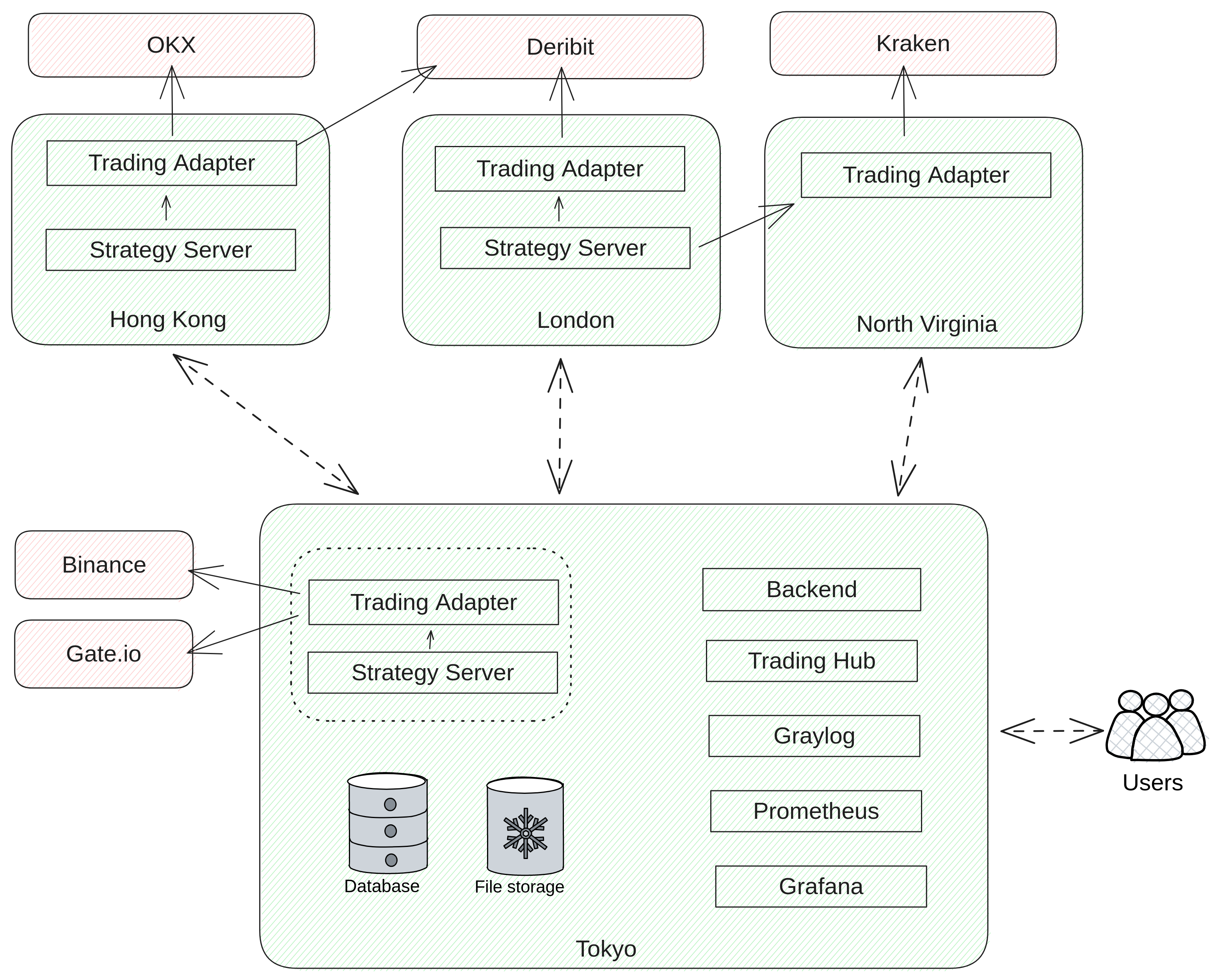
Example architecture
Primary region
The primary region hosts the core backend services: system control, monitoring, data storage, and the user-facing interfaces and APIs. It can also host trading components (Strategy Server, Trading Adapter), which is useful when most trading activity is concentrated there.
In the diagram above, Tokyo is the primary region. It manages the overall system and runs local trading infrastructure.
Other regions
Any number of additional regions can run alongside the primary region. Each runs its own Strategy Servers and Trading Adapters, placing strategies close to the exchanges they trade against to cut order round-trip times.
Deployment topology
The typical layout puts one Strategy Server and one Trading Adapter on each hardware server. A Strategy Server can connect to multiple Trading Adapters when it needs to reach exchanges in different regions.
Two examples:
-
A Strategy Server in London trades on Deribit (London) and Kraken (North Virginia) by connecting to separate Trading Adapters in each region.
-
A Strategy Server in Tokyo trades on Binance and Gate.io through a single local Trading Adapter.
Both layouts are valid. Pick based on latency, account, and strategy requirements.
CryptoStruct also operates dedicated lines between regions that provide better network latency than regular internet connections.
Backend components
Backend
The Backend is an Apache-served web application that is the central interface for managing and monitoring the trading system.
What it does:
- Manages strategy instances across all regions
- Adds and removes Strategy Servers and Trading Adapters
- Manages trading accounts and connections
- Shows wallets, positions, open orders, and trades
- Shows real-time PnL and market data
- Provides manual order entry (click trading)
- Browses supported exchanges and instruments
The backend also exposes HTTP APIs for external tools, providing:
- Master data and statistics for exchanges and instruments
- Trading data published by components such as the Trading Adapter
Trading Hub
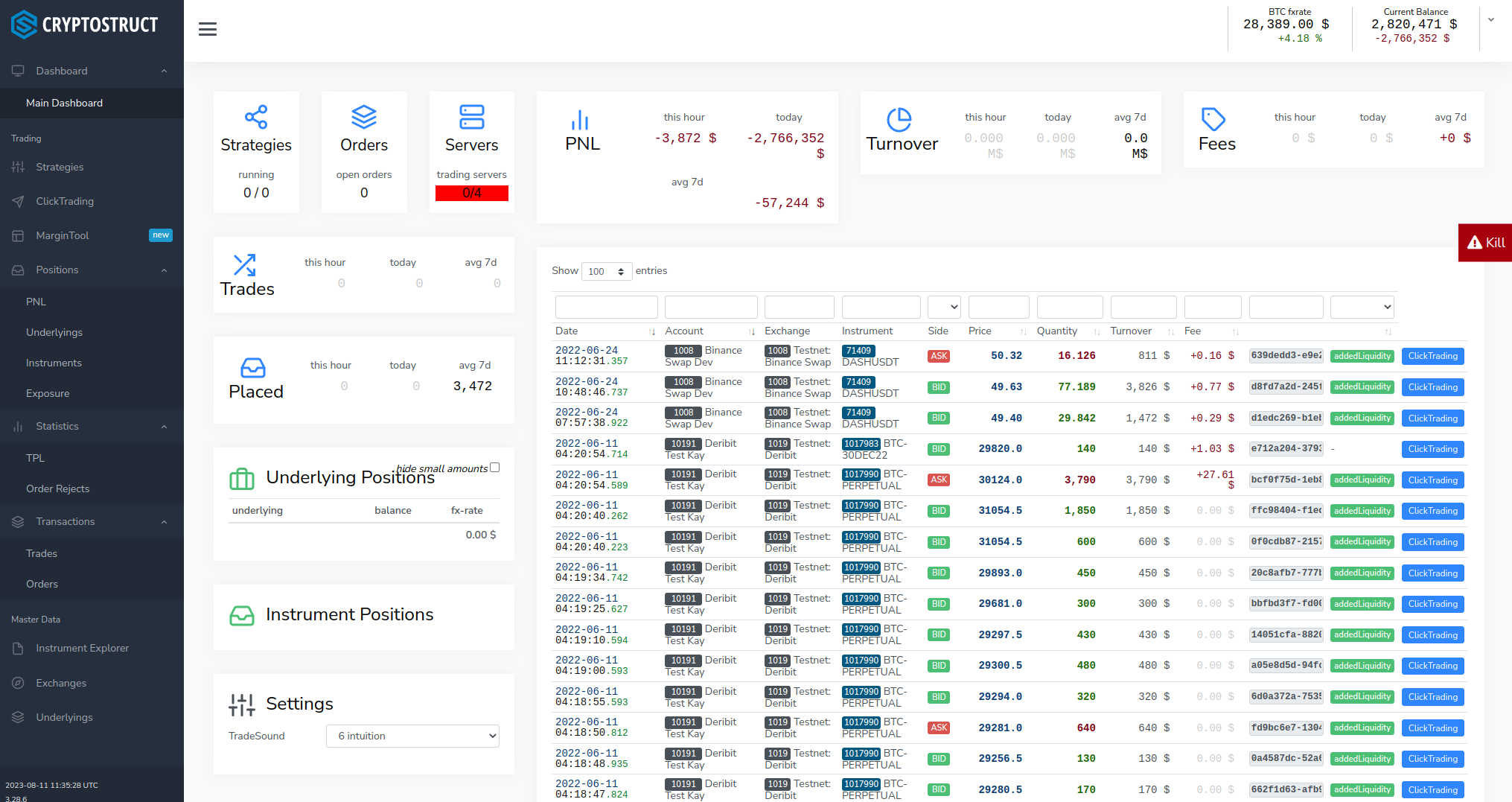
The Trading Hub connects to all Trading Adapters and the Market Data Service. It supports manual click trading, monitors public market data, and displays the trading activity of running strategies in real time.
Graylog (optional)
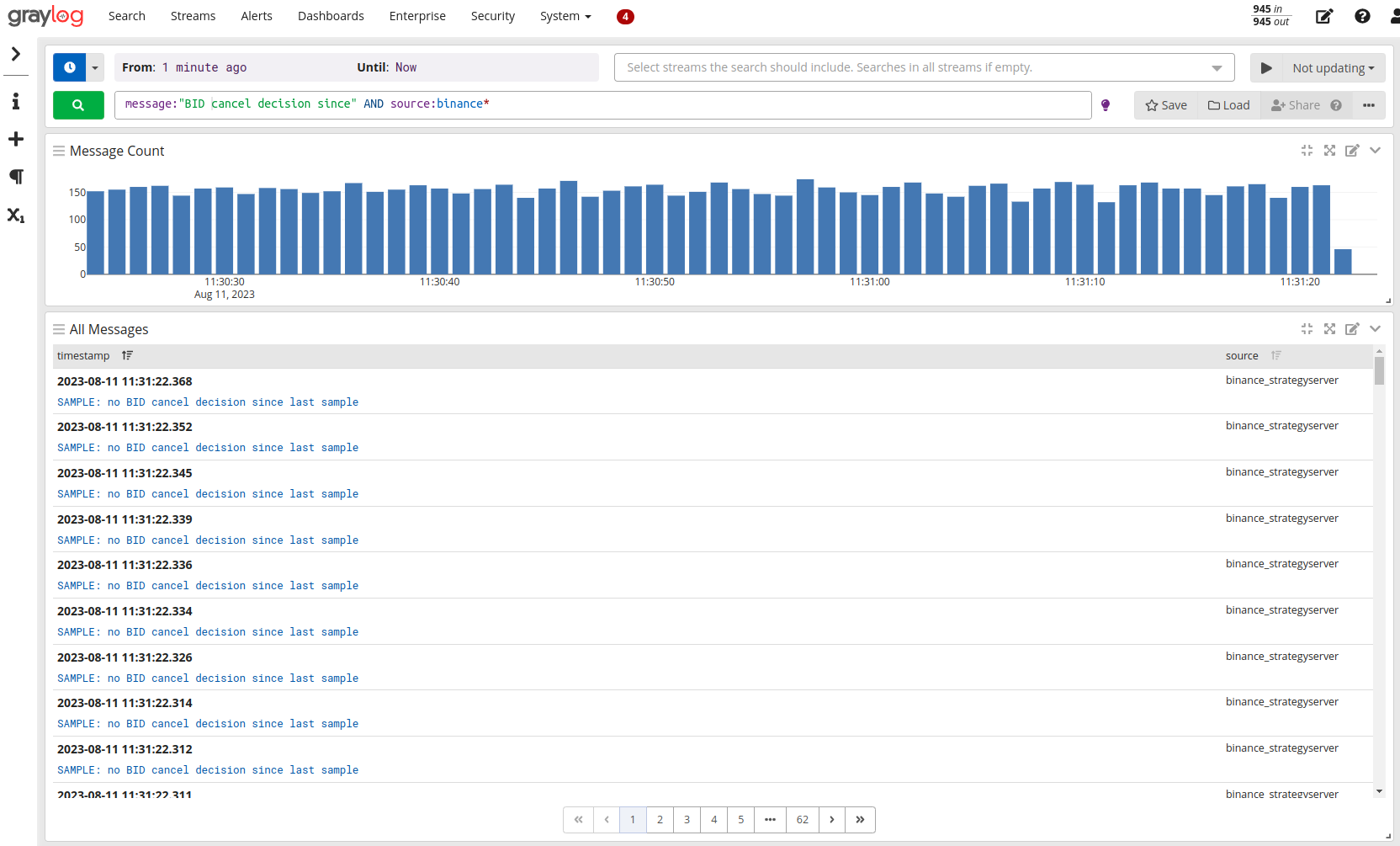
Graylog collects and indexes log messages from every system component, with centralised search and filtering.
Prometheus and Grafana (optional)
-
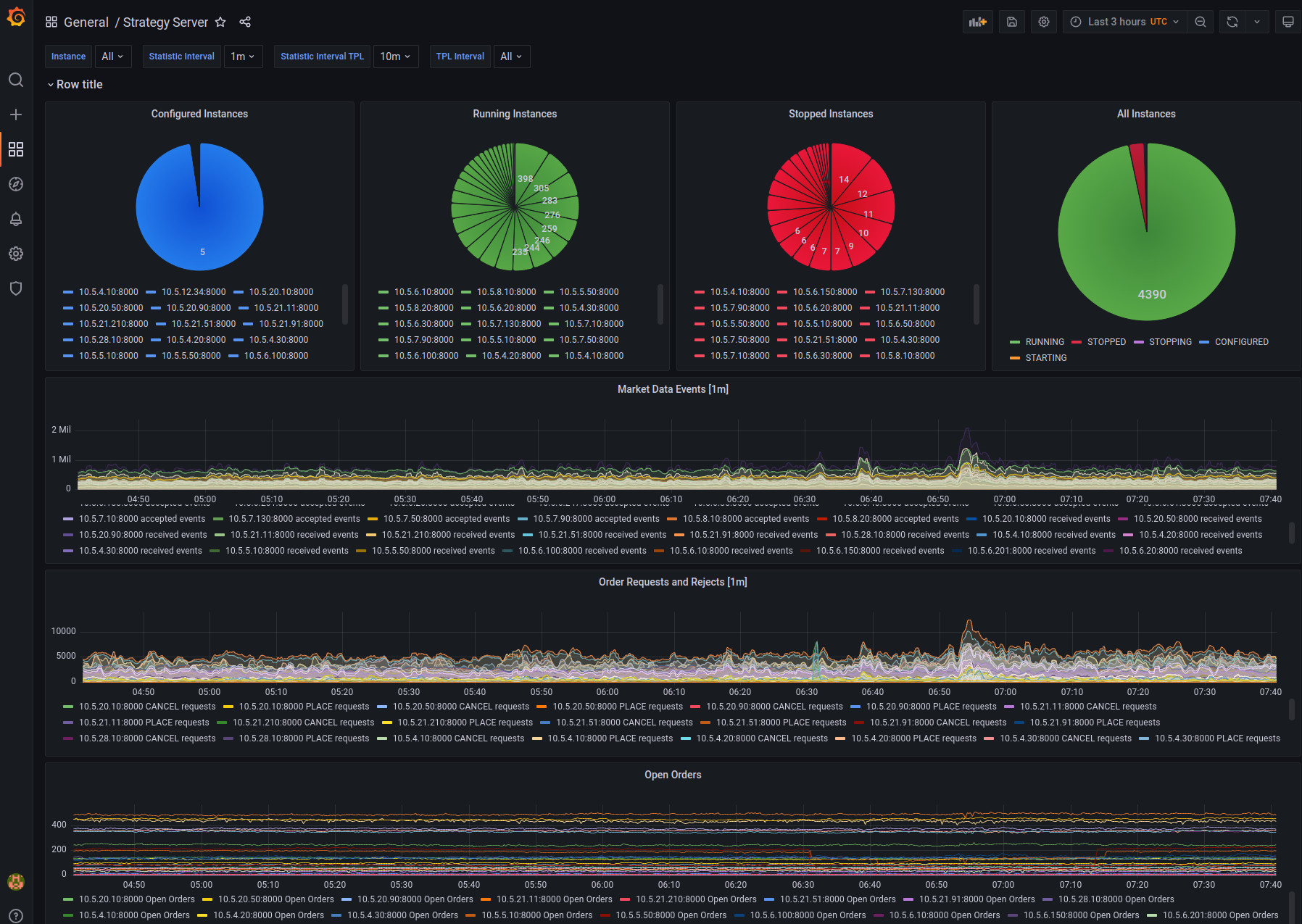
Prometheus collects and stores metrics on performance, health, and trading activity from the other components.
-
Grafana visualises those metrics. Ready-to-use dashboards for latencies and trading activity ship out of the box.
Core trading components
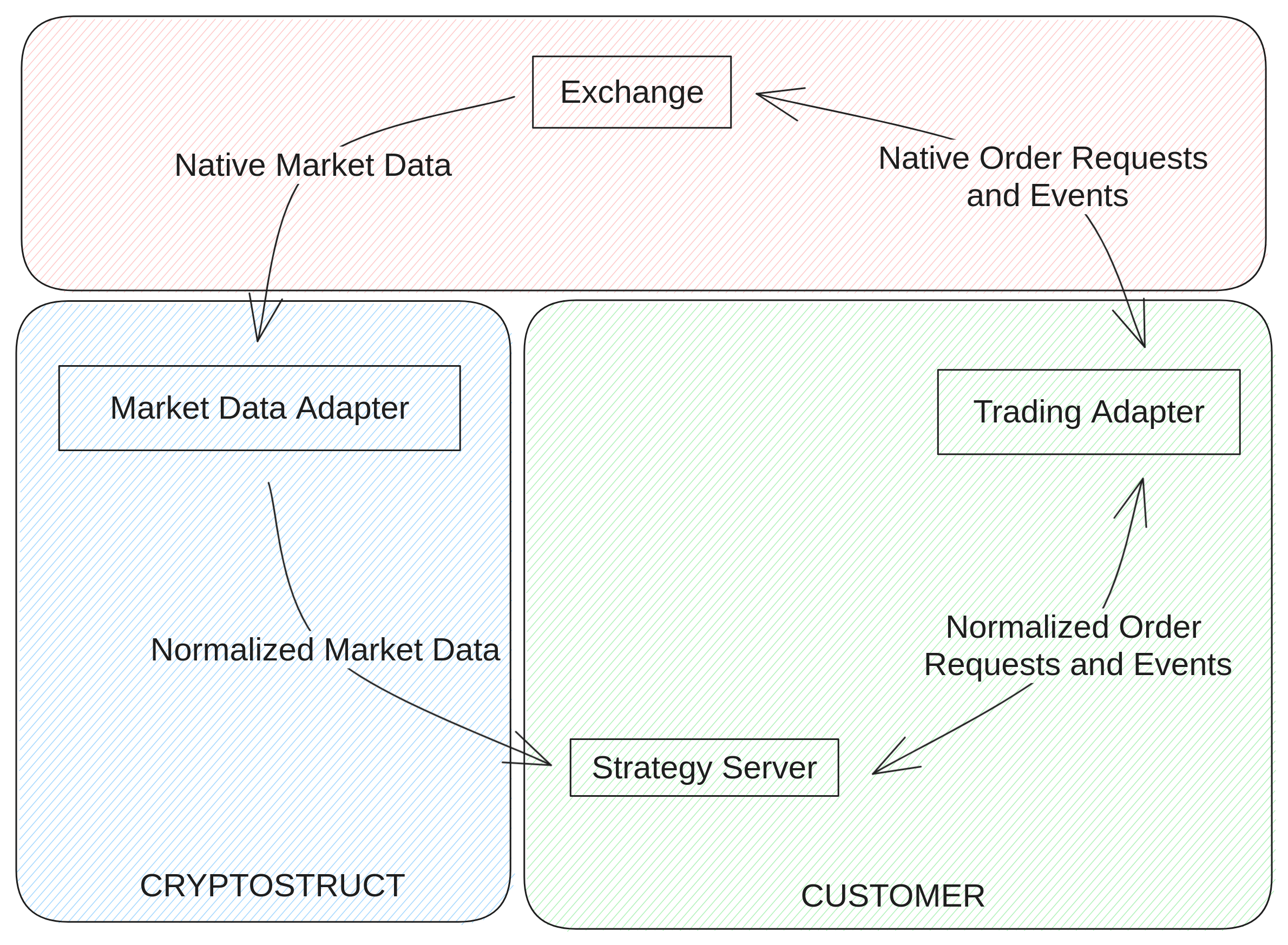
The Market Data Adapter (MDA), Strategy Server (STR), and Trading Adapter (TA) are the three components that move market data, run strategies, and flow orders. All three are built for high throughput and low latency.
Market Data Adapter (MDA)
The MDA is part of the managed CryptoStruct Market Data Service. It provides low-latency real-time data streams.
- Normalises native exchange data into the CryptoStruct Market Data Protocol
- Maintains multiple connections to an exchange for redundancy and latency optimisation
Strategy Server (STR)
The STR runs the strategies you write with the SDK.
- Connects to multiple MDAs and TAs for data and order routing
- Distributes strategy instances across CPU cores to balance load
- Routes market data and trading events to the right strategy instance
- Enforces per-account and per-instrument risk limits
- Calculates Theoretical Profit and Loss (TPL) for every strategy
Trading Adapter (TA)
Each trading account is bound to a TA, which talks to the exchange and handles all trading events for that account.
-
Maintains multiple connections to exchanges for all accounts
-
Normalises native exchange order-entry protocols into the CryptoStruct format
-
Speaks WebSocket, REST, and FIX (whichever the exchange offers)
-
Tracks and enforces rate limits to prevent the user from being blocked due to violations
-
Reports orders and trades back to the backend